
Compound interest: why long-term investing wins
Beginner-friendly Updated September 2026
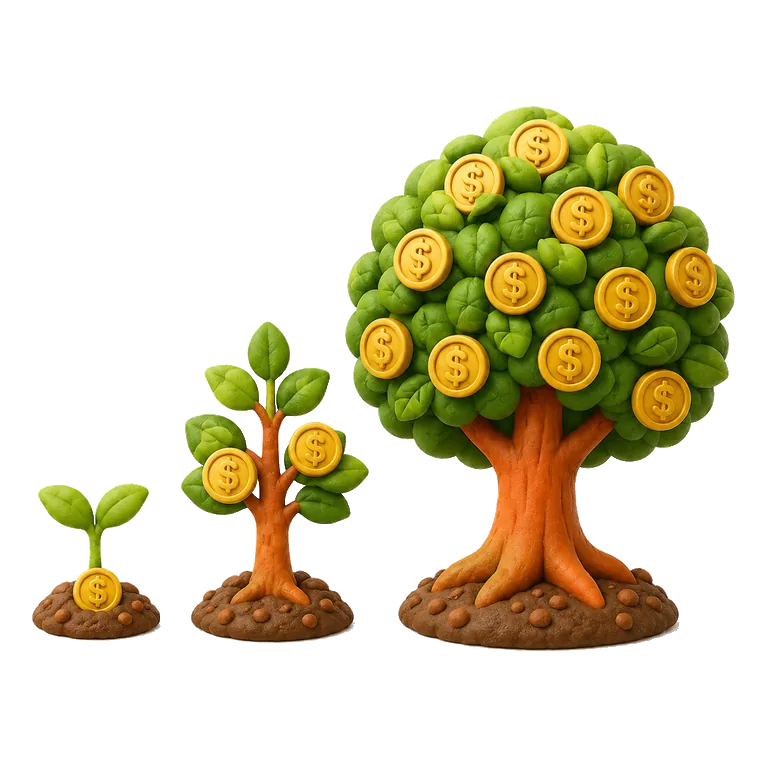
Compound interest is the money your money earns, plus the money that those earnings go on to earn. When you keep your returns invested instead of taking them out, those returns start earning returns of their own. Do that for many years and your balance grows faster and faster. This is the single biggest reason patient, long-term investors win.
If finance words make you nervous, relax. We will keep it plain, use real examples from the Pakistan Stock Exchange (PSX) and the US market, and define every term the moment we use it.
What is compound interest in simple words?
Think of a snowball at the top of a hill. You start with a small ball. As it rolls, it picks up snow. The bigger it gets, the more snow it grabs with each turn. Soon a tiny ball becomes a boulder.
Your money works the same way:
- Year 1: You invest, and you earn a return on what you put in.
- Year 2: You earn a return on your original money and on last year's return.
- Year 10+: Most of your growth now comes from past gains, not from your original money.
Return just means the profit your investment makes, through rising share prices (see how you make money from stocks) or through dividends (a slice of company profit paid to shareholders, covered in what is a dividend).
How is compound interest different from simple interest?
Simple interest pays you only on your original amount. Compound interest pays you on your original amount and on every gain you have already earned. That small difference becomes enormous over time.
Say you invest Rs 100,000 and earn 15% a year:
- Simple interest: Rs 15,000 every year. After 20 years you have Rs 400,000.
- Compound interest: each year's 15% is calculated on a bigger balance. After 20 years you have about Rs 1,636,000, four times more.
Same starting money. Same rate. The only difference is that compounding lets your gains keep working instead of sitting idle.
How does compounding actually work? A worked example
You invest Rs 100,000 once and leave it alone, earning 15% per year (close to long-run PSX averages for strong companies):
- Year 1: Rs 100,000 → Rs 115,000 (earned Rs 15,000)
- Year 5: about Rs 201,000 (you've doubled)
- Year 10: about Rs 404,000
- Year 20: about Rs 1,636,000
- Year 30: about Rs 6,621,000
Notice the shape. In the first decade you gained around Rs 300,000. In the third decade alone you gained over Rs 4,000,000. The growth is not a straight line; it bends upward. That curve is compounding, and the steepest part comes at the end, which is exactly why time matters more than timing.
Why does compound interest reward long-term investing?
Because the biggest gains arrive late. The investor who stays in for 30 years doesn't just get a bit more than the one who stays 15 years. They get many times more. Leaving early means you skip the best part of the ride.
Real companies show this clearly:
- Apple (AAPL): a few thousand dollars invested in the mid-2000s and simply held, with dividends reinvested, would be worth a small fortune today. The people who won were not clever traders. They were patient holders.
- Lucky Cement (LUCK) and Fauji Fertilizer (FFC) on the PSX: long-term holders earned both rising share prices and years of dividends. Reinvesting those dividends bought more shares, which paid more dividends, the snowball again.
- Oil & Gas Development (OGDC): a large, dividend-paying PSX name where reinvested payouts have quietly compounded for patient shareholders over many years.
The lesson isn't "buy these specific stocks." It's that staying invested in good companies, and reinvesting what they pay you, is what turns ordinary savings into real wealth.
What are the three ingredients of compounding?
Every compounding story needs the same three things:
- 1. Time. The most powerful ingredient, and the one you can never buy back. Starting at 25 instead of 35 can double your final result, even with the same monthly amount.
- 2. Rate of return. How much your money grows each year. A higher rate compounds faster, but chasing wild returns usually means wild risk. Steady beats spectacular.
- 3. Consistency. Adding money regularly and never cashing out the gains. The classic beginner habit is investing a fixed amount every month, called dollar-cost averaging, so you keep feeding the snowball in good times and bad.
The Rule of 72: a 5-second shortcut
Want to know how long it takes your money to double? Divide 72 by your yearly return:
- At 15% a year: 72 ÷ 15 = about 5 years to double.
- At 10% a year: 72 ÷ 10 = about 7 years to double.
- At 6% a year: 72 ÷ 6 = 12 years to double.
This is why the rate you earn matters so much. At 15%, money invested in your twenties can double five or six times before you retire, and each double is bigger than the last.
What's the biggest mistake beginners make?
Selling too soon. People get nervous when prices dip, sell, and miss the recovery, breaking the chain that compounding depends on. Compounding only works if you stay in. A few common traps:
- Waiting for the "perfect" moment. Time in the market beats timing the market. The best day to start was years ago; the second-best is today.
- Spending the dividends. Reinvesting them is what makes the snowball roll faster.
- Panic-selling on dips. Drops are normal and temporary; quality companies recover and keep growing.
If you want to invest in line with your values, you can build a long-term portfolio from screened halal names. See our halal stocks list for PSX.
You don't need to be rich or a finance expert to begin. You need a little money, a long horizon, and the discipline to leave it alone. Create a free account to research companies, track dividends, and watch your own snowball start to roll.
The power of consistency
You don't need to be rich to start, you just need to start. Slide to see how a small monthly investment can grow.
Orange line = your investment's value; grey dashed = what you put in. Assumes ~12%/yr average return, compounded monthly, illustrative, not a guarantee.
Key takeaways
- Compound interest means your returns earn their own returns. Your gains start making gains, so growth speeds up the longer you stay invested.
- Time is the most powerful ingredient: the biggest gains come in the final years, so starting early matters far more than picking the perfect moment.
- Rs 100,000 at 15% a year grows to about Rs 1.6 million in 20 years and Rs 6.6 million in 30, same money, just more time compounding.
- Reinvest your dividends instead of spending them; that's what made long-term holders of FFC, LUCK and Apple wealthy.
- Use the Rule of 72: divide 72 by your yearly return to estimate how many years it takes your money to double (72 ÷ 15 ≈ 5 years).
Track your halal portfolio free
Screen any PSX or US stock for Sharia compliance, track your portfolio, and get weekly AI picks, free.
Get started freeFrequently asked questions
What is compound interest in the simplest terms?
It is the money your money earns, plus the money that those earnings go on to earn. When you keep your returns invested instead of spending them, each year's growth is calculated on a bigger and bigger balance, like a snowball picking up more snow as it rolls downhill.
How is compound interest different from simple interest?
Simple interest pays you only on your original amount, so the gain is the same every year. Compound interest pays you on your original amount and on all the gains you've already earned, so each year's gain is larger than the last. Over 20 to 30 years, compounding produces many times more money than simple interest.
How long does it take to double my money?
Use the Rule of 72: divide 72 by your yearly return. At 15% a year your money doubles in about 5 years; at 10% in about 7 years; at 6% in 12 years. The higher and more consistent your return, the faster each doubling happens.
Why does compounding favour long-term investors?
Because the largest gains arrive in the later years. The growth curve bends upward over time, so an investor who stays in for 30 years earns far more than double what a 15-year investor earns. Selling early, or panic-selling on a dip, breaks the chain and skips the best part.
Do I need a lot of money to benefit from compound interest?
No. Compounding rewards time and consistency, not size. Investing a small fixed amount every month (dollar-cost averaging) and reinvesting any dividends lets even modest savings snowball into a meaningful sum over the years. The key is to start now and leave it invested.
Keep learning
What Is a Dividend Reinvestment Plan (DRIP)? | Market Canvas AI
Read guideHow do you make money from stocks?
Read guideWhat Is Dollar-Cost Averaging? A Beginner's Guide
Read guideWhat Is a Dividend? (and How Dividend Yield Works)
Read guideGet the weekly investing email
New beginner guides plus the Sharia-compliant stocks our AI is watching. One short email a week. Free, and you can unsubscribe anytime.
No spam. Unsubscribe anytime. We never share your email.
Educational only, not financial advice.