Candlestick charts explained for beginners
Intermediate Updated September 2026
A candlestick chart is a picture of price. Each little candle is a tiny story of what buyers and sellers did during one slice of time. Once you can read one candle, you can read a whole chart. This guide takes you from zero to confident, using real stocks like OGDC, LUCK, FFC, and Apple.
What is a candlestick, in one sentence?
A candlestick is a single shape that packs four prices into one symbol: the open (where price started), the close (where it ended), the high (the top), and the low (the bottom) for a chosen time period.
Think of it like a daily diary entry for a stock. If the candle covers one day, that one shape tells you the stock's whole day at a glance, without reading a single number.
What do the parts of a candle mean?
Every candle has two parts. Learn these two and you are most of the way there.
- The body, the thick rectangle, shows the distance between the open and the close. A tall body means a big move. A short body means a small move.
- The wicks (also called shadows or tails), the thin lines sticking out the top and bottom, show the highest and lowest prices reached, even if price did not stay there.
Picture a candle on a table. The wax body is the body. The bits of wick poking out the top and bottom are the wicks. Simple.
What do green and red candles mean?
Colour tells you the direction in one glance:
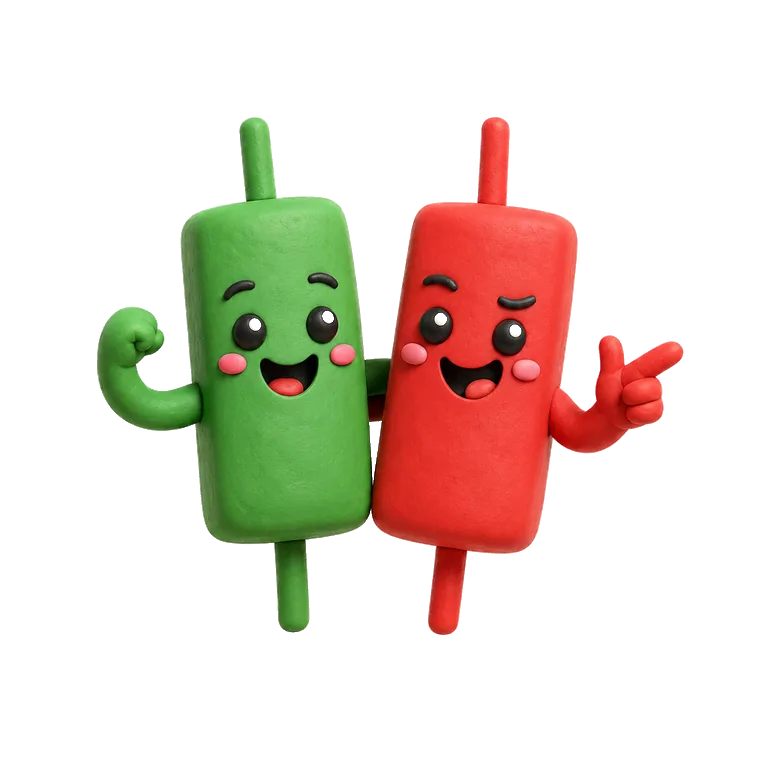
- Green candle (bullish): the close was higher than the open. Buyers won that period. Price went up.
- Red candle (bearish): the close was lower than the open. Sellers won that period. Price went down.
Quick definitions, since finance loves jargon: bullish just means "expecting prices to rise" (a bull thrusts its horns up). Bearish means "expecting prices to fall" (a bear swipes its paw down). That is the whole secret behind those two scary words.
For green candles, the open sits at the bottom of the body and the close at the top. For red candles it flips: the open is at the top and the close is at the bottom. The colour tells you which is which.
A worked example: reading one daily candle
Imagine a single daily candle for OGDC (Oil & Gas Development Company on the PSX). The day's numbers are:
- Open: Rs 150
- Low: Rs 148
- High: Rs 156
- Close: Rs 154
Here is how that becomes a candle:
- The close (154) is higher than the open (150), so the candle is green.
- The body stretches from 150 (bottom) to 154 (top), a solid up-day.
- The top wick reaches up to 156. Price touched 156 but buyers could not hold it, so it slipped back to close at 154.
- The bottom wick dips to 148. Sellers pushed price down early, but buyers stepped in and lifted it.
In plain words: "OGDC opened, dipped a little, then buyers took over and pushed it up to close strong near the day's high." That is the story one green candle tells.
Why do traders prefer candlesticks over a plain line?
A line chart only joins the closing prices. It is clean, but it hides the drama. A candlestick keeps the full story.
Take Apple on a volatile day. A line chart might show it closing flat. But the candle could have a long lower wick, revealing that price crashed during the day and then fought all the way back. That long tail is a clue the line chart throws away. If you are still getting comfortable with chart basics, start with our guide on how to read a stock chart.
What is a candlestick "pattern"?
One candle is a word. A few candles together form a sentence, and that is a pattern. Patterns hint at what might happen next. A few beginner-friendly ones:
- Doji: open and close are almost equal, so the body is a tiny line. It means buyers and sellers tied. Often a sign of indecision or a possible turning point. If FFC (Fauji Fertilizer) prints a doji after a long climb, the rally may be running out of breath.
- Hammer: a small body with a long lower wick, like a hammer head with a handle. It says sellers tried to crush the price but buyers slammed it back up. Often spotted near a bottom.
- Engulfing: a big candle whose body completely swallows the previous candle's body. A green one swallowing a red one suggests buyers have grabbed control.
There is no need to memorise dozens of patterns on day one. Patterns are far more reliable when you read them alongside levels where price tends to stall or bounce. See support and resistance explained.
How do candlesticks fit into the bigger picture?
Candlesticks are the alphabet of charts. Reading the chart is reading the words. The full craft of using charts to make decisions is called technical analysis, and candlesticks are the first thing every analyst learns.
One honest caution: a single candle never guarantees the future. LUCK (Lucky Cement) can print a perfect green hammer and still fall the next day, because news, earnings, and the wider market all push prices around. Candles tilt the odds; they do not promise outcomes. Always pair them with the company's fundamentals and your own risk plan.
Quick start: read your first chart today
Open any stock chart and try this, candle by candle:
- Is it green or red? (Up day or down day.)
- Is the body tall or short? (Big move or small move.)
- Are the wicks long? (Was there a fight before price settled?)
Do that for ten candles and the chart stops looking like noise and starts looking like a conversation. You can practise on Sharia-screened names from our halal PSX stocks list, or create a free account to track them with clean, beginner-friendly charts.
Key takeaways
- A candlestick packs four prices into one shape: open, close, high, and low for a set time period.
- Green means the price closed higher than it opened (buyers won); red means it closed lower (sellers won).
- The thick body shows the open-to-close move; the thin wicks show the highest and lowest prices reached.
- Several candles together form patterns like doji, hammer, and engulfing that hint at what may come next.
- Candlesticks tilt the odds but never guarantee the future; always combine them with fundamentals and a risk plan.
Track your halal portfolio free
Screen any PSX or US stock for Sharia compliance, track your portfolio, and get weekly AI picks, free.
Get started freeFrequently asked questions
What does a green candle mean on a stock chart?
A green candle means the stock closed higher than it opened during that time period, so buyers were in control and the price rose. For a green candle the open is at the bottom of the body and the close is at the top.
What is the difference between the body and the wick of a candle?
The body is the thick rectangle showing the distance between the open and close prices. The wicks (or shadows) are the thin lines above and below the body, showing the highest and lowest prices reached during that period, even if price did not stay there.
Are candlestick charts good for beginners?
Yes. Once you learn just two things, the body and the wicks, candlesticks are very beginner-friendly because each candle visually tells you the open, close, high, low, and direction at a glance, far more than a plain line chart shows.
Can a candlestick predict the future price?
No. Candlesticks show what already happened and can tilt the odds about what comes next, but they never guarantee it. News, earnings, and the wider market move prices, so always pair candle reading with company fundamentals and a clear risk plan.
What time period does one candle cover?
Whatever you choose. On a daily chart each candle is one trading day; on an hourly chart each candle is one hour; on a one-minute chart each candle is one minute. The four prices (open, close, high, low) always refer to that single period.
Keep learning
How to Read a Stock Chart (Step by Step)
Read guideWhat Is Technical Analysis? A Beginner's Guide
Read guideWhat Are Support and Resistance Levels? A Beginner Guide
Read guideGet the weekly investing email
New beginner guides plus the Sharia-compliant stocks our AI is watching. One short email a week. Free, and you can unsubscribe anytime.
No spam. Unsubscribe anytime. We never share your email.
Educational only, not financial advice.